-
SHOP
-
Self Learning Management Books
-
Test Prep Books
-
Legend In Marketing
-
Legend In Consumer Behavior
-
Legend In Strategic Marketing
RESOURCESSPOTLIGHTS -
- Log in
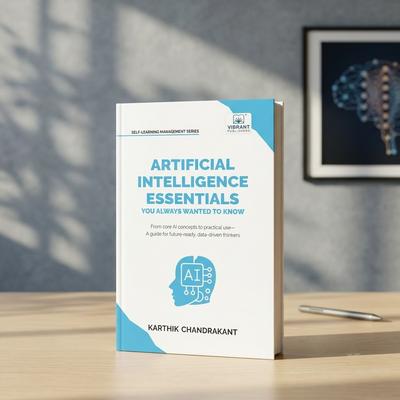
Artificial Intelligence Essentials You Always Wanted to Know
Estimated delivery between August 30 and September 01.
We use cookies and similar technologies to provide the best experience on our website.
Artificial Intelligence Essentials You Always Wanted to Know
Master AI Fundamentals, ML Techniques, NLP, Deep Learning, and Generative AI to Build Real-World Skills and Ethical AI Solutions
Request Sample Book / Online Resource
Enter your email and choose the resource type. We'll send access to your inbox.
Description
Learn AI, Machine Learning, and Deep Learning in One Easy-to-Understand Guide
Artificial Intelligence is transforming the way we live, work, and interact—but understanding it doesn’t have to be overwhelming.
Artificial Intelligence Essentials You Always Wanted to Know is a clear, engaging, and practical introduction to AI—perfect for business professionals, career switchers, tech enthusiasts, and lifelong learners.
From understanding how AI models are built to exploring cutting-edge technologies like Neural Networks and Generative AI, each chapter breaks down complex ideas into manageable sections—complete with summaries and quizzes to reinforce key learnings.
Key Features of the Book
A Clear Introduction to AI
Learn how AI has evolved and how it’s transforming industries from finance and healthcare to retail and education.
Foundational Concepts Made Simple
Understand how AI solves problems, the three core learning paradigms, and the basics of model development.
Machine Learning Techniques Explained
Dive into key methods like regression, classification, and clustering, and discover when to apply them in real-world scenarios.
Deep Learning Demystified
Explore neural networks, CNNs, and RNNs, and understand how deep learning is driving innovation in various fields.
Explore Core AI Domains
- Natural Language Processing (NLP) – Learn how machines process and generate human language.
- Computer Vision (CV) – Discover how AI understands the visual world.
- Generative AI – Learn the basics of prompt engineering, large language models (LLMs), and content creation.
Bonus: Online Job Prep Support
Access exclusive interview questions to help you prepare for roles in a rapidly growing job market.
Take the first step toward mastering AI and equip yourself for the future that's already unfolding.
Bibliographic Details
Pages: 264 Pages
Paperback (ISBN): 9781636516387
Hardback (Color): 9781636516400
Trim Size: 5.5” x 8.5”
Category: Business & Economics
Author: Karthik Chandrakant,Vibrant Publishers
Table of Contents
1 Introduction to Artificial Intelligence (AI)
1.1 Evolution of AI
1.2 Latest Trends in AI
1.3 AI Applications in Business
1.4 The Future of AI: A World of Possibilities
Chapter Summary
Quiz
2 Fundamentals of AI
2.1 Problem-Solving Journey Using AI
2.2 Supervised, Unsupervised, and Reinforcement Learning
2.3 AI Techniques
2.4 How to Build and Train an AI Model
Chapter Summary
Quiz
3 Machine Learning Techniques
3.1 Regression
3.2 Classification
3.3 Clustering
3.4 Key ML Algorithms and When to Use Them
3.5 Application of Machine Learning Algorithms
Chapter Summary
Quiz
4 Deep Learning
4.1 Introduction to Deep Learning (DL)
4.2 Neural Networks
4.3 Convolutional Neural Networks (CNNs)
4.4 Recurrent Neural Networks (RNNs)
4.5 Why is Deep Learning Becoming So Popular?
4.6 Challenges in Deep Learning
4.7 Application of Deep Learning Algorithms
Chapter Summary
Quiz
5 Natural Language Processing (NLP)
5.1 Fundamentals of NLP
5.2 NLP Project Pipeline
5.3 Transformers
5.4 Applications of NLP
Chapter Summary
Quiz
6 Computer Vision (CV)
6.1 Introduction and Evolution of Computer Vision
6.2 Key Components of Computer Vision
6.3 Object Detection
6.4 Image Generation: Generative Adversarial Networks (GANs)
6.5 Computer Vision Libraries
6.6 Applications of Computer Vision
Chapter Summary
Quiz
7 Generative AI
7.1 Introduction to Generative AI
7.2 Evolution of Generative AI
7.3 The Current Generative AI Landscape
7.4 Prompt Engineering
7.5 Large Language Models (LLMs)
7.6 Real-World Applications of GenAI
7.7 Conclusion
Chapter Summary
8 Ethical AI
8.1 Introduction to Ethical AI
8.2 Bias in AI
8.3 Transparency and Explainability
8.4 Governance in AI
8.5 Designing Ethical AI Systems
8.6 Conclusion
Chapter Summary
References
Glossary"
Author
Karthik Chandrakant is a TEDx speaker and AI leader with 13+ years at Amazon and Mu Sigma, known for demystifying AI and mentoring future innovators.
Vibrant Publishers is focused on presenting the best texts for learning about technology and business as well as books for test preparation. Categories include programming, operating systems and other texts focused on IT. In addition, a series of books helps professionals in their own disciplines learn the business skills needed in their professional growth.
Vibrant Publishers has a standardized test preparation series covering the GMAT, GRE and SAT, providing ample study and practice material in a simple and well organized format, helping students get closer to their dream universities.
Series
The Self-Learning Management Series is designed to help students, new managers, career switchers, and entrepreneurs learn essential management lessons and covers every aspect of business, from HR to Finance to Marketing to Operations across any and every industry. Each book includes basic fundamentals, important concepts, and standard and well-known principles as well as practical ways of application of the subject matter.
Editorial Reviews
The author breaks down complex architectures into actionable insights, making it the perfect guide for both beginners and experts. A must-read for any professional working in the AI space looking to stay at the forefront of language model innovation.
-- Mani Garlapati, Sr. Technical Program Manager, Google
This works as an excellent textbook, moving up the ladder of complexity of concepts necessary for anybody wanting to be an AI Engineer. The real-life examples at the end of each section are a must read.
-- Kalpit Bhawalkar, Head of AI, Konverge AI
This book offers a systematic, instructor-ready framework that prepares students for meaningful AI use in professional settings. By grounding instruction in concrete examples, relevant conceptual distinctions, and applied decision-making frameworks, it avoids surface-level tool training and instead cultivates disciplined and principled thinking. The result is a learning experience that enables instructors to teach with intention and students to develop the practical, ethical competence required to embed AI responsibly into real business workflows.
-- Karl R. LaPan
Director, UF Innovate | Accelerate
The University of Florida
Some technology books feel like they are sprinting ahead, scattering jargon and assume you will keep up. This book doesn’t. It slows down. It feels like it was written by someone who remembers what it is like to be curious before being confident.There is no pressure to already understand AI. The author begins with the questions people usually ask–What is AI actually doing? Why does it matter? Where does human thinking end and machine learning begin? As a book lover, I appreciated that. I don’t want to be impressed by complexity; I want to be invited to understand it. The explanations are calm and clear. Concepts like machine learning and neural networks don’t feel like paths you are guided along. You are never made to feel behind for not knowing something already. Instead, understanding builds quietly, until words that once felt intimidating start to feel familiar.What stayed with me most is how human the book feels. AI isn’t treated as a cold, distant force but as something shaped by human choices, data and values. The reminder running through the book is simple and lasting; AI reflects us. This isn’t a book you rush through. I paused often, not from confusion, but from thought, noticing how deeply AI has already woven itself into daily life. That is what good books do, they follow you beyond the pages.It is not a technical manual, and it won’t turn you into an engineer or an expert. But if you want to understand before specializing, this book offers a steady, welcome foundation.By the end, I didn’t feel overwhelmed. I felt clearer, calmer and more curious. For a subject as vast and fast-moving as artificial intelligence, that is a quiet achievement.
-- Himsekha Rai, NetGalley Reviewer
This book is good for those interested in AI regardless of their level of understanding.
I learned the history, how the concept was developed. I learned about the vast amounts of data required and about the various ways of organizing and interpreting data for productive use. I appreciate the practical examples, such as how email programs identify spam and how visual recognition programs work. As the programs advanced, examples of how programs recognize and interpret human speech are given and how generative programs can create text and images.
I also learned that the programs can make mistakes with a few examples given. The latest programs available are listed with suggestions for use depending on what an individual wants to do with it. The ethical issues are also covered, giving examples of how the programs can be used to deceive people.
This is a very interesting book, much of it understandable by people not involved in programming.
-- Joan Nienhuis, Reviewer, Book Reviews from an Avid Reader
I really enjoyed Artificial Intelligence Essentials You Always Wanted to Know because it finally made AI feel understandable instead of overwhelming. The explanations of machine learning, deep learning, NLP, and generative AI are clear, well structured, and written for people who are curious rather than those already having technical expertise, which I appreciated so much. I loved the way the book balances theory with real-world applications and practical examples, plus the summaries and quizzes actually helped reinforce what I was learning instead of feeling like a filler. It’s the kind of guide that builds confidence as you read, and I finished it feeling informed, less intimidated, and genuinely excited about how AI fits into everyday life.
-- Marta Petticoat, NetGalley Reviewer
A concise yet comprehensive guide covering the full spectrum of modern AI, from core ML/DL to the latest in GenAI and ethics. Highly recommended for building foundational literacy.
-- Vinodh Balaraman, Co-founder & CEO, KolateAI Inc
Supplemental Resources
You may also like
(100)
Machine Learning Essentials You Always Wanted to Know
(100)
Machine Learning Essentials You Always Wanted to Know
(20)
Graph Machine Learning Essentials
(20)
Graph Machine Learning Essentials
- 5 stars: 80 (68%)
- 4 stars: 37 (32%)
- 3 stars: 0 (0%)
- 2 stars: 0 (0%)
- 1 star: 0 (0%)
This was my first serious dive into artificial intelligence, and the friendly tone kept me reading. Building up from basic concepts to generative AI made even the harder topics feel reachable. The emphasis on responsible, thoughtful use stood out to me.
I run a business and needed to understand AI well enough to make smart decisions, not to code it. This book focuses on applied thinking and principled use rather than just tools, which is exactly what I needed. It helped me evaluate where AI genuinely fits in my company.
This was my first real dive into AI and the friendly tone kept me reading to the end. Building from basic concepts up to generative AI made even the harder topics feel reachable. The focus on responsible, thoughtful use stood out and shaped how I think about the technology.
A very well-written book. It provides straightforward insights into supervised vs unsupervised learning, cognitive computing, and future AI trends.
I work in marketing and wanted to understand how AI could apply to my field without drowning in technical detail. The book strikes a nice balance and the generative AI section was directly relevant to my work. A little more on practical tools would have made it perfect for me.
The real-world case studies explaining AI implementation, algorithmic bias, and automated decision-making frameworks make this an essential strategic guide.
Every chapter concludes with review questions and key takeaway summaries that reinforce retention. An excellent handbook for IT professionals.
I work in marketing and wanted to grasp how AI could apply to my field without heavy jargon. The generative AI chapter was directly relevant and easy to follow. A little more on practical tools would have made it perfect, but it is a strong introduction.
An exceptional compilation. The complete overview of modern AI history, current technologies, and future trends makes this a mandatory read for tech enthusiasts.
If you want to understand how artificial intelligence is shaping modern industries without reading confusing academic papers, this guide is the ideal starting point.
This handbook demystifies complex AI concepts such as machine learning paradigms, neural networks, natural language processing, and computer vision into accessible, easy-to-digest chapters.
Studying on my own, I needed something that assumed no prior AI knowledge, and this was ideal. Each topic from NLP to computer vision is introduced simply before adding detail. I finished with a solid mental map of how the field fits together.
A concise overview that strips away all the unnecessary industry jargon. Clear, actionable insights for anyone curious about algorithms and everyday data platforms.
Studying independently, I needed a resource that assumed no prior knowledge, and this was exactly right. Each topic from NLP to computer vision is introduced simply before adding detail. I finished with a solid mental map of how the whole field fits together.
Studying computer science, I found this an accessible way to see how the pieces of AI fit together. The friendly tone made dense topics like deep learning feel manageable. A few more diagrams would have helped, but overall a solid starting point.
This book offers a well-structured breakdown of AI concepts, neural networks, machine learning paradigms, and natural language processing. Perfect for non-technical readers and executives.
It touches upon crucial aspects like ethics in AI alongside technical definitions. I highly value this balanced perspective on modern AI evolution.
The clean formatting, informative infographics, and chapter summaries make learning about generative AI and machine learning fast and intuitive.
I run AI awareness sessions for non technical teams and this book has become my main reference. The instructor friendly structure makes it easy to turn chapters into lessons. Participants respond well to the real world examples and the approachable tone.
I am a senior operations manager at a supply chain company in Chicago who was increasingly expected to evaluate AI vendor proposals, participate in AI steering committee meetings, and lead teams deploying AI-assisted tools - all without any formal AI background. This book by Karthik Chandrakant - a TEDx speaker and AI leader with 13-plus years at Amazon and Mu Sigma - became the resource that made those responsibilities manageable. His eight-chapter structure moves from AI history and problem-solving paradigms through ML techniques, deep learning, NLP, computer vision, generative AI, and responsible AI governance with the calm clarity of someone who has actually built AI systems at organizational scale. The chapter on generative AI - covering LLMs, prompt engineering, and real-world GenAI applications - was the single most practically useful chapter I have read this year. Chapter quizzes and a comprehensive glossary support self-directed revision efficiently. An outstanding single-volume AI education for business professionals.
I am a Chief Technology Officer at a mid-sized healthcare company in Denver and have been searching for a single, authoritative resource that I can confidently recommend to senior leaders across clinical, operations, and commercial functions who need to understand AI at a meaningful depth. Most books are either too academic for busy executives or too shallow to be genuinely useful. Karthik Chandrakant's eight-chapter structure occupies exactly the right middle ground. His background - 13-plus years of AI leadership at Amazon and Mu Sigma - gives every chapter the practitioner authority that academic AI texts cannot replicate. The generative AI chapter on LLMs, prompt engineering, and real-world GenAI applications is the most current and practically relevant treatment of this topic I have found at any level. The responsible AI chapter on bias, transparency, and governance is essential reading for healthcare AI contexts where these considerations directly affect patient outcomes and regulatory compliance. An indispensable organizational resource for any leadership team navigating AI adoption.
I am a marketing analytics manager at an e-commerce company in Pune who was tasked with evaluating AI tools for customer segmentation and personalization. I understood marketing data well but had almost no AI conceptual background. This book changed that in under four weeks of focused reading. Karthik Chandrakant's chapter on ML techniques - covering supervised and unsupervised learning, regression, classification, and clustering with business use cases - gave me the vocabulary to evaluate vendor claims critically. The NLP chapter was directly applicable to our customer feedback analysis use case. The responsible AI chapter on bias, explainability, and ethical governance was something I had not expected from a beginner-level text, but it turned out to be one of the most useful sections for our internal AI policy discussions. A compact, authoritative, and well-applied AI primer.
I am a senior data analyst at a BFSI company in Kolkata who was asked to lead our organization's AI adoption roadmap despite having only limited formal AI training. This book was the primary resource I used to prepare for that responsibility. Karthik Chandrakant's treatment of ML techniques - covering regression, classification, and clustering with business use cases rather than mathematical abstractions - gave me the vocabulary to evaluate vendors and communicate with our data science team credibly. The NLP chapter's coverage of transformer architectures and real-world language applications was directly relevant to the customer-facing AI tools we were assessing. The responsible AI chapter - addressing bias, transparency, explainability, and governance frameworks - was the section our compliance team found most useful when I shared it. The career guidance and interview questions for AI roles at the end of the book were a welcome bonus for my own professional development. A genuinely transformative single-volume AI resource.
I coordinate the data science curriculum at a private university in Ankara and have been evaluating beginner-to-intermediate AI books for potential adoption across our undergraduate and postgraduate business technology programs. This volume by Karthik Chandrakant is among the strongest I have reviewed at this level for a mixed technical and non-technical student audience. The eight-chapter structure - progressing from AI fundamentals through ML, deep learning, NLP, computer vision, generative AI, and ethical AI - is logically sequenced and pedagogically sound. The computer vision chapter's treatment of object detection, GANs, and CV libraries alongside the historical evolution of the field is more substantive than I expected for an essentials-level text. The ethical AI chapter on bias, explainability, and governance gives instructors excellent discussion material for business ethics integration. Chapter quizzes support classroom assessment effectively. A well-authored and academically credible single-volume AI primer.
I am a product director at a fintech startup in Bengaluru who had been struggling to build genuine AI literacy beyond surface-level familiarity with tools like ChatGPT. Most resources I tried were either too mathematical or too superficial to be useful for the product decisions I needed to make. This book by Karthik Chandrakant resolved that frustration entirely. His writing style - clearly shaped by years of TEDx speaking and strategic AI roles at Amazon and Mu Sigma - explains transformer architectures, LLMs, and prompt engineering in a way that is rigorous enough to be genuinely informative without requiring a computer science background. The NLP chapter gave me the conceptual framework I needed to evaluate natural language AI features for our product roadmap. The machine learning chapter's accessible treatment of supervised and unsupervised learning connected theory to the real recommendation and fraud detection systems we work with daily. The responsible AI section completed the picture with governance awareness I now apply to every AI vendor evaluation. An outstanding resource.
I am a software architect at an IT consulting firm in Chennai who had strong programming skills but significant gaps in AI and ML conceptual knowledge - particularly around the newer generative AI developments that are reshaping our industry. This book filled those gaps efficiently. Karthik Chandrakant's chapter on generative AI - covering large language models, prompt engineering, and real-world GenAI applications - is the most clearly written non-mathematical treatment of these topics I have encountered at any level. The NLP chapter's coverage of transformer architecture and the deep learning chapter's treatment of CNNs and RNNs are equally strong. What makes this book stand out is the author's ability to connect each technical concept to concrete business applications - a skill that reflects his TEDx speaking experience and strategic AI roles across Amazon and Infogain. Thoroughly recommended for technical professionals building AI breadth.
I am a director of innovation at a financial services firm in Chicago and have been recommending AI resources to colleagues across all seniority levels for the past two years. Most books either drown beginners in mathematics or stay so conceptually thin that they offer nothing beyond what a Wikipedia search would provide. Karthik Chandrakant's book occupies exactly the right middle ground. His background - 13-plus years at Amazon and Mu Sigma, combined with TEDx speaking experience - gives the writing a practical, confident authority that makes complex topics like transformer architectures, GANs, and reinforcement learning accessible without oversimplification. The generative AI chapter on LLMs and prompt engineering is the most current and practically useful chapter I have read in any AI essentials book. The ethical AI chapter adds the governance awareness that enterprise professionals genuinely need. An outstanding single-volume AI education.
Contact Information
Got questions? Call us on
+91 9987-44-0099
Need help with your order?
india@vibrantpublishers.com
Available 24/7 via whatsapp chat
+1-315-413-6418
*Test names are the registered trademarks of their respective owners, who are not affiliated with Vibrant Publishers.
© 2026,
Vibrant Publishers India.