Black Friday Is Active Now!
Expert-Authored Books
Updated Editions
Fast Shipping
Trusted by 10,00,000+ Readers
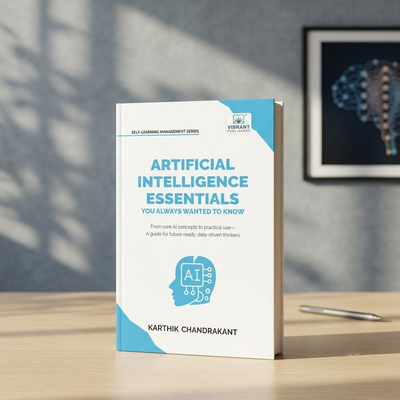
A book titled 'Artificial Intelligence Essentials' by Karthik Chandrakant.
Artificial Intelligence Essentials You Always Wanted to Know

Artificial Intelligence Essentials You Always Wanted to Know

Master AI Fundamentals, ML Techniques, NLP, Deep Learning, and Generative AI to Build Real-World Skills and Ethical AI Solutions

★★★★★ (4.8/5) Rated by 1,200+ Readers
₹ 490.00 M.R.P: ₹ 899.00 SAVE 45%
Extra Prepaid Discounts + Free Gift at Checkout

Complete Your Learning Bundle

Buy all 3 titles together and get a FREE mouse pad

This bookArtificial Intelligence Essentials You Always Wanted to Know
Artificial Intelligence Essentials You Always Wanted to Know
₹ 490.00 ₹ 490.00
FREE
Free Mouse Pad Exclusive gift when you buy all 3 books
🔒 Add all books

Description

Learn AI, Machine Learning, and Deep Learning in One Easy-to-Understand Guide

Artificial Intelligence is transforming the way we live, work, and interact—but understanding it doesn’t have to be overwhelming.

Artificial Intelligence Essentials You Always Wanted to Know is a clear, engaging, and practical introduction to AI—perfect for business professionals, career switchers, tech enthusiasts, and lifelong learners.

From understanding how AI models are built to exploring cutting-edge technologies like Neural Networks and Generative AI, each chapter breaks down complex ideas into manageable sections—complete with summaries and quizzes to reinforce key learnings.

Key Features of the Book

A Clear Introduction to AI

Learn how AI has evolved and how it’s transforming industries from finance and healthcare to retail and education.

Foundational Concepts Made Simple

Understand how AI solves problems, the three core learning paradigms, and the basics of model development.

Machine Learning Techniques Explained

Dive into key methods like regression, classification, and clustering, and discover when to apply them in real-world scenarios.

Deep Learning Demystified

Explore neural networks, CNNs, and RNNs, and understand how deep learning is driving innovation in various fields.

Explore Core AI Domains

  • Natural Language Processing (NLP) – Learn how machines process and generate human language.
  • Computer Vision (CV) – Discover how AI understands the visual world.
  • Generative AI – Learn the basics of prompt engineering, large language models (LLMs), and content creation.

Bonus: Online Job Prep Support

Access exclusive interview questions to help you prepare for roles in a rapidly growing job market.

Take the first step toward mastering AI and equip yourself for the future that's already unfolding.

Bibliographic Details

Pages:  264 Pages

Paperback (ISBN):  9781636516387

Hardback (Color): 9781636516400

Trim Size: 5.5” x 8.5”

Category: Business & Economics

Author: Karthik Chandrakant,Vibrant Publishers

Table of Contents

1 Introduction to Artificial Intelligence (AI)
1.1 Evolution of AI
1.2 Latest Trends in AI
1.3 AI Applications in Business
1.4 The Future of AI: A World of Possibilities
Chapter Summary
Quiz

2 Fundamentals of AI
2.1 Problem-Solving Journey Using AI
2.2 Supervised, Unsupervised, and Reinforcement Learning
2.3 AI Techniques
2.4 How to Build and Train an AI Model
Chapter Summary
Quiz

3 Machine Learning Techniques
3.1 Regression
3.2 Classification
3.3 Clustering
3.4 Key ML Algorithms and When to Use Them
3.5 Application of Machine Learning Algorithms
Chapter Summary
Quiz

4 Deep Learning
4.1 Introduction to Deep Learning (DL)
4.2 Neural Networks
4.3 Convolutional Neural Networks (CNNs)
4.4 Recurrent Neural Networks (RNNs)
4.5 Why is Deep Learning Becoming So Popular?
4.6 Challenges in Deep Learning
4.7 Application of Deep Learning Algorithms
Chapter Summary
Quiz

5 Natural Language Processing (NLP)
5.1 Fundamentals of NLP
5.2 NLP Project Pipeline
5.3 Transformers
5.4 Applications of NLP
Chapter Summary
Quiz

6 Computer Vision (CV)
6.1 Introduction and Evolution of Computer Vision
6.2 Key Components of Computer Vision
6.3 Object Detection
6.4 Image Generation: Generative Adversarial Networks (GANs)
6.5 Computer Vision Libraries
6.6 Applications of Computer Vision
Chapter Summary
Quiz

7 Generative AI
7.1 Introduction to Generative AI
7.2 Evolution of Generative AI
7.3 The Current Generative AI Landscape
7.4 Prompt Engineering
7.5 Large Language Models (LLMs)
7.6 Real-World Applications of GenAI
7.7 Conclusion
Chapter Summary

8 Ethical AI
8.1 Introduction to Ethical AI
8.2 Bias in AI
8.3 Transparency and Explainability
8.4 Governance in AI
8.5 Designing Ethical AI Systems
8.6 Conclusion
Chapter Summary

References
Glossary"

Author

Karthik Chandrakant is a TEDx speaker and AI leader with 13+ years at Amazon and Mu Sigma, known for demystifying AI and mentoring future innovators.

Vibrant Publishers is focused on presenting the best texts for learning about technology and business as well as books for test preparation. Categories include programming, operating systems and other texts focused on IT. In addition, a series of books helps professionals in their own disciplines learn the business skills needed in their professional growth.

Vibrant Publishers has a standardized test preparation series covering the GMAT, GRE and SAT, providing ample study and practice material in a simple and well organized format, helping students get closer to their dream universities.

Series

The Self-Learning Management Series is designed to help students, new managers, career switchers, and entrepreneurs learn essential management lessons and covers every aspect of business, from HR to Finance to Marketing to Operations across any and every industry. Each book includes basic fundamentals, important concepts, and standard and well-known principles as well as practical ways of application of the subject matter.

Editorial Reviews

The author breaks down complex architectures into actionable insights, making it the perfect guide for both beginners and experts. A must-read for any professional working in the AI space looking to stay at the forefront of language model innovation.
-- Mani Garlapati, Sr. Technical Program Manager, Google

This works as an excellent textbook, moving up the ladder of complexity of concepts necessary for anybody wanting to be an AI Engineer. The real-life examples at the end of each section are a must read.
-- Kalpit Bhawalkar, Head of AI, Konverge AI

This book offers a systematic, instructor-ready framework that prepares students for meaningful AI use in professional settings. By grounding instruction in concrete examples, relevant conceptual distinctions, and applied decision-making frameworks, it avoids surface-level tool training and instead cultivates disciplined and principled thinking. The result is a learning experience that enables instructors to teach with intention and students to develop the practical, ethical competence required to embed AI responsibly into real business workflows.
-- Karl R. LaPan
Director, UF Innovate | Accelerate
The University of Florida

Some technology books feel like they are sprinting ahead, scattering jargon and assume you will keep up. This book doesn’t. It slows down. It feels like it was written by someone who remembers what it is like to be curious before being confident.There is no pressure to already understand AI. The author begins with the questions people usually ask–What is AI actually doing? Why does it matter? Where does human thinking end and machine learning begin? As a book lover, I appreciated that. I don’t want to be impressed by complexity; I want to be invited to understand it. The explanations are calm and clear. Concepts like machine learning and neural networks don’t feel like paths you are guided along. You are never made to feel behind for not knowing something already. Instead, understanding builds quietly, until words that once felt intimidating start to feel familiar.What stayed with me most is how human the book feels. AI isn’t treated as a cold, distant force but as something shaped by human choices, data and values. The reminder running through the book is simple and lasting; AI reflects us. This isn’t a book you rush through. I paused often, not from confusion, but from thought, noticing how deeply AI has already woven itself into daily life. That is what good books do, they follow you beyond the pages.It is not a technical manual, and it won’t turn you into an engineer or an expert. But if you want to understand before specializing, this book offers a steady, welcome foundation.By the end, I didn’t feel overwhelmed. I felt clearer, calmer and more curious. For a subject as vast and fast-moving as artificial intelligence, that is a quiet achievement.
-- Himsekha Rai, NetGalley Reviewer

This book is good for those interested in AI regardless of their level of understanding.

I learned the history, how the concept was developed. I learned about the vast amounts of data required and about the various ways of organizing and interpreting data for productive use. I appreciate the practical examples, such as how email programs identify spam and how visual recognition programs work. As the programs advanced, examples of how programs recognize and interpret human speech are given and how generative programs can create text and images.

I also learned that the programs can make mistakes with a few examples given. The latest programs available are listed with suggestions for use depending on what an individual wants to do with it. The ethical issues are also covered, giving examples of how the programs can be used to deceive people.

This is a very interesting book, much of it understandable by people not involved in programming.
-- Joan Nienhuis, Reviewer, Book Reviews from an Avid Reader

I really enjoyed Artificial Intelligence Essentials You Always Wanted to Know because it finally made AI feel understandable instead of overwhelming. The explanations of machine learning, deep learning, NLP, and generative AI are clear, well structured, and written for people who are curious rather than those already having technical expertise, which I appreciated so much. I loved the way the book balances theory with real-world applications and practical examples, plus the summaries and quizzes actually helped reinforce what I was learning instead of feeling like a filler. It’s the kind of guide that builds confidence as you read, and I finished it feeling informed, less intimidated, and genuinely excited about how AI fits into everyday life.
-- Marta Petticoat, NetGalley Reviewer

A concise yet comprehensive guide covering the full spectrum of modern AI, from core ML/DL to the latest in GenAI and ethics. Highly recommended for building foundational literacy.
-- Vinodh Balaraman, Co-founder & CEO, KolateAI Inc

Supplemental Resources
  • 5 stars: 104 (66%)
  • 4 stars: 53 (34%)
  • 3 stars: 0 (0%)
  • 2 stars: 0 (0%)
  • 1 star: 1 (1%)
S
SKR

The book is extremely basic and falls well short of expectations. However, the advertisement is impressively misleading, creating an exaggerated impression of its actual value and quality

D
Dinh Van Phuc (Vietnam)
Accessible and genuinely engaging

This was my first serious dive into artificial intelligence, and the friendly tone kept me reading. Building up from basic concepts to generative AI made even the harder topics feel reachable. The emphasis on responsible, thoughtful use stood out to me.

E
Elnur Babayev (Azerbaijan)
Perfect for non-technical leaders

I run a business and needed to understand AI well enough to make smart decisions, not to code it. This book focuses on applied thinking and principled use rather than just tools, which is exactly what I needed. It helped me evaluate where AI genuinely fits in my company.

C
Cao Thi Ngoc (Vietnam)
Engaging and genuinely clear

This was my first real dive into AI and the friendly tone kept me reading to the end. Building from basic concepts up to generative AI made even the harder topics feel reachable. The focus on responsible, thoughtful use stood out and shaped how I think about the technology.

A
Arthit Somchai (Thailand)
Great Foundation for Professionals Transitioning into AI Roles

A very well-written book. It provides straightforward insights into supervised vs unsupervised learning, cognitive computing, and future AI trends.

W
Wanida Tangsiri (Thailand)
Useful for non-technical professionals

I work in marketing and wanted to understand how AI could apply to my field without drowning in technical detail. The book strikes a nice balance and the generative AI section was directly relevant to my work. A little more on practical tools would have made it perfect for me.

M
Meera Ramakrishnan (India)
Practical Primer for Business Leaders and Technology Managers

The real-world case studies explaining AI implementation, algorithmic bias, and automated decision-making frameworks make this an essential strategic guide.

S
Sarika Wattana (Thailand)
Structured and Highly Informative Desk Guide

Every chapter concludes with review questions and key takeaway summaries that reinforce retention. An excellent handbook for IT professionals.

M
Malai Suksawat (Thailand)
Accessible for non-technical readers

I work in marketing and wanted to grasp how AI could apply to my field without heavy jargon. The generative AI chapter was directly relevant and easy to follow. A little more on practical tools would have made it perfect, but it is a strong introduction.

B
Bui Hoang Nam (Vietnam)
Top Recommended Guide for AI Fundamentals

An exceptional compilation. The complete overview of modern AI history, current technologies, and future trends makes this a mandatory read for tech enthusiasts.

P
Pranav Deshmukh (India)
Perfect Resource for Self-Paced AI Study

If you want to understand how artificial intelligence is shaping modern industries without reading confusing academic papers, this guide is the ideal starting point.

D
Dominic Thorne (USA)
Clear and Engaging Introduction to Artificial Intelligence

This handbook demystifies complex AI concepts such as machine learning paradigms, neural networks, natural language processing, and computer vision into accessible, easy-to-digest chapters.

K
Kamran Valiyev (Azerbaijan)
A clear entry into the world of AI

Studying on my own, I needed something that assumed no prior AI knowledge, and this was ideal. Each topic from NLP to computer vision is introduced simply before adding detail. I finished with a solid mental map of how the field fits together.

T
Tran Thi Mai (Vietnam)
Highly Recommend for AI Curious Readers

A concise overview that strips away all the unnecessary industry jargon. Clear, actionable insights for anyone curious about algorithms and everyday data platforms.

R
Ravan Aghazade (Azerbaijan)
A clear entry point into AI

Studying independently, I needed a resource that assumed no prior knowledge, and this was exactly right. Each topic from NLP to computer vision is introduced simply before adding detail. I finished with a solid mental map of how the whole field fits together.

D
Duong Thi Kim (Vietnam)
Clear introduction to AI concepts

Studying computer science, I found this an accessible way to see how the pieces of AI fit together. The friendly tone made dense topics like deep learning feel manageable. A few more diagrams would have helped, but overall a solid starting point.

N
Nathaniel Cross (USA)
Clear and Engaging Introduction to Artificial Intelligence

This book offers a well-structured breakdown of AI concepts, neural networks, machine learning paradigms, and natural language processing. Perfect for non-technical readers and executives.

S
Sarah Jenkins (USA)
Insightful and Well-Structured Book

It touches upon crucial aspects like ethics in AI alongside technical definitions. I highly value this balanced perspective on modern AI evolution.

P
Praveen Nadar (India)
Perfect for corporate training

I run AI awareness sessions for non technical teams and this book has become my main reference. The instructor friendly structure makes it easy to turn chapters into lessons. Participants respond well to the real world examples and the approachable tone.

S
Sevinj Guliyeva (Azerbaijan)
Well Written with Clear Visual Diagrams and Concept Summaries

The clean formatting, informative infographics, and chapter summaries make learning about generative AI and machine learning fast and intuitive.

L
Lauren Prescott (USA)
Used This Book to Prepare for an AI Strategy Role Interview — Got the Job

I was applying for an AI strategy role at a consulting firm and needed to demonstrate that I could discuss AI concepts, implementation frameworks, and business applications credibly in interview discussions. Artificial Intelligence Essentials gave me exactly the preparation I needed. The structured framework for approaching AI problems, the coverage of ML techniques and deep learning at a conceptual level, and the Generative AI section were all directly relevant to the conversations I had across three rounds of interviews. The interviewing panel specifically commented on how clearly I could articulate AI trade-offs and strategic considerations. I give this book significant credit for that outcome.

H
Harshita Malhotra (India)
The Right Starting Point for Professionals Transitioning Into AI Roles

I spent six years in marketing analytics and wanted to move into a more AI-focused data science role. Most AI books I found were either too theoretical or too deep into mathematics for my background. This one struck exactly the right balance. It covers the foundational concepts of AI clearly, connects them to real-world business applications, and - crucially - helps you understand how to position and communicate AI solutions in a professional context. The guidance on balancing experimentation with outcome-driven execution is something I haven't seen covered this clearly anywhere else at an introductory level.

C
Cassandra Whitmore (USA)
A Smart Investment Before Starting Any Formal AI Course or Certification

I was about to enroll in an AI and machine learning certification program and wanted some foundational reading to ensure I wouldn't be completely lost in the first few weeks. Artificial Intelligence Essentials was exactly the right pre-reading - it gave me a conceptual map of the AI landscape, explained the strategic logic behind AI frameworks, and introduced key vocabulary without overwhelming me with formulas or code. When my certification program started, I was already comfortable with the foundational ideas and could focus on learning the technical implementation rather than fighting the concepts. A well-pitched and genuinely useful entry point into AI.

R
Raymond Ashford (USA)
The AI Book That Finally Made Strategy Click for a Non-Technical Executive

I'm a VP of Digital Transformation and have sat through countless AI presentations without truly understanding how to evaluate what we were being sold or how to frame problems for our data science team. Artificial Intelligence Essentials changed that. Karthik Chandrakant's 13-plus years at Amazon and Mu Sigma are evident in how practically the content is framed - this is an AI book written by someone who has applied it at scale, not someone who only teaches theory. The sections on framing AI problems strategically and designing scalable solutions are particularly valuable for business leaders who need to direct AI initiatives rather than build them.

D
Devansh Kapoor (India)
Clear, Practical, and Written by Someone Who Has Actually Built AI Solutions

Too many AI books are written by academics who have never deployed a model in production. This one reads differently from the first chapter. The author's experience leading AI initiatives at Amazon and Mu Sigma gives the content a grounded, practitioner's perspective that is rare at this introductory level. The book explains how AI frameworks enable faster, more accurate business decisions in language that both technical and non-technical readers can follow. I've recommended it to three colleagues who are at different stages of their AI learning journey and all three found it equally valuable from their respective starting points.

C
Cynthia Whitmore (USA)
The One AI Book I Now Give to Every New Member of My Leadership Team

I am a Chief Technology Officer at a mid-sized healthcare company in Denver and have been searching for a single, authoritative resource that I can confidently recommend to senior leaders across clinical, operations, and commercial functions who need to understand AI at a meaningful depth. Most books are either too academic for busy executives or too shallow to be genuinely useful. Karthik Chandrakant's eight-chapter structure occupies exactly the right middle ground. His background - 13-plus years of AI leadership at Amazon and Mu Sigma - gives every chapter the practitioner authority that academic AI texts cannot replicate. The generative AI chapter on LLMs, prompt engineering, and real-world GenAI applications is the most current and practically relevant treatment of this topic I have found at any level. The responsible AI chapter on bias, transparency, and governance is essential reading for healthcare AI contexts where these considerations directly affect patient outcomes and regulatory compliance. An indispensable organizational resource for any leadership team navigating AI adoption.

R
Reginald Stafford (USA)
The AI Book That Made Every Chapter Feel Like a Conversation With an Expert

I am a senior operations manager at a supply chain company in Chicago who was increasingly expected to evaluate AI vendor proposals, participate in AI steering committee meetings, and lead teams deploying AI-assisted tools - all without any formal AI background. This book by Karthik Chandrakant - a TEDx speaker and AI leader with 13-plus years at Amazon and Mu Sigma - became the resource that made those responsibilities manageable. His eight-chapter structure moves from AI history and problem-solving paradigms through ML techniques, deep learning, NLP, computer vision, generative AI, and responsible AI governance with the calm clarity of someone who has actually built AI systems at organizational scale. The chapter on generative AI - covering LLMs, prompt engineering, and real-world GenAI applications - was the single most practically useful chapter I have read this year. Chapter quizzes and a comprehensive glossary support self-directed revision efficiently. An outstanding single-volume AI education for business professionals.

S
Sinan Kaya (Turkey)
The Clearest Beginner AI Book I Have Reviewed for University Adoption

I coordinate the data science curriculum at a private university in Ankara and have been evaluating beginner-to-intermediate AI books for potential adoption across our undergraduate and postgraduate business technology programs. This volume by Karthik Chandrakant is among the strongest I have reviewed at this level for a mixed technical and non-technical student audience. The eight-chapter structure - progressing from AI fundamentals through ML, deep learning, NLP, computer vision, generative AI, and ethical AI - is logically sequenced and pedagogically sound. The computer vision chapter's treatment of object detection, GANs, and CV libraries alongside the historical evolution of the field is more substantive than I expected for an essentials-level text. The ethical AI chapter on bias, explainability, and governance gives instructors excellent discussion material for business ethics integration. Chapter quizzes support classroom assessment effectively. A well-authored and academically credible single-volume AI primer.