Expert-Authored Books
Updated Editions
Fast Shipping
Trusted by 50,000+ Readers
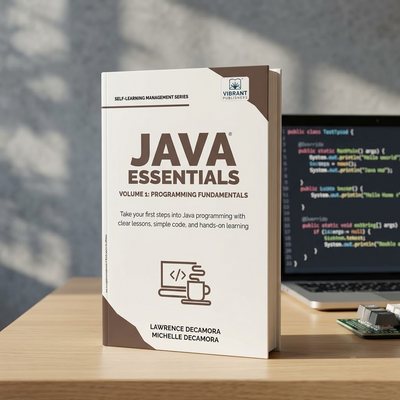
Java Essentials Volume 1: Programming Fundamentals

Java Essentials Volume 1: Programming Fundamentals

Learn Java, Variables, Control Flow, and Methods with Hands-On Coding Exercises and Examples for Beginners

★★★★★ (4.8/5) Rated by 1,200+ Readers
45% OFF | Limited-Time Offer
₹ 490.00 M.R.P: ₹ 899.00
Offer Ends In
00 h
:
00 m
:
00 s
Extra Discount is Waiting for You at Checkout
Description
  • Beginner-friendly explanations
  • Illustrative code snippets
  • Emphasis on clean syntax and good coding practices
  • Coding tasks for hands-on learning

Java Essentials Volume 1: Programming Fundamentals is a comprehensive and beginner-friendly guide designed for anyone seeking a solid foundation in Java programming. Whether you're a self-learner, student, or educator, this volume offers a well-structured and practical introduction to the essentials of Java, blending theory and hands-on examples in a clear and engaging way.

This book introduces readers to the Java programming language with an emphasis on clarity, pedagogy, and real-world relevance. The content is structured to reflect the actual learning curve of new programmers, starting from how to set up the Java Development Kit (JDK) all the way to mastering core programming constructs such as variables, data types, operators, control flow, methods, strings, arrays, and more.

Key topics covered include:

  • Downloading, installing, and configuring the JDK on your Machine
  • Understanding Java program structure
  • Declaring and using variables and constants
  • Using operators and expressions effectively
  • Writing conditional and loop-based logic
  • Creating and using methods
  • Working with strings, arrays, and user input
  • Applying good coding practices and debugging techniques

This book is ideal for:

  • First-year computer science students
  • Senior high school students in ICT or programming strands
  • Hobbyists and professionals transitioning into software development
  • Instructors looking for beginner-level curriculum support

By the end of the book, learners will be confident in writing functional Java programs and well-prepared for more advanced topics like object-oriented programming, which will be covered in Volume 2.

Bibliographic Details

Pages: 275 pages

Paperback (ISBN): 9781636515021

Trim Size: 5.5” x 8.5”

Category: Business & Economics

Author: Lawrence G. Decamora, Michelle C. Decamora, Vibrant Publishers

Table of Contents

0. Downloading, Installing, and Configuring the Java Development Kit (JDK)
0.1 Where Do I Get My Java Development Kit (JDK)?
0.2 Downloading the Correct JDK For Your Machine
0.3 Installing the JDK in Mac OS X
0.4 Installing the JDK for your Windows Operating Environment
0.5 JDK Installer for Linux Operating Environment
Chapter Summary
Quiz
JDK Installation Task


1. Your First Java Cup
1.1 The Key Features of Java
1.2 The Three Flavors of Java
1.3 JDK vs. JRE
1.4 The Java Runtime Environment (JRE)
1.5 The Garbage Collector
1.6 Three Tasks Performed By Java in Handling Code Security
Chapter Summary
Quiz
Further Reflection


2. Writing Your First Java Program
2.1 “HelloWorld”: Your First Java Application
2.2 The System.out.println() Method
2.3 Debugging Compile-Time Errors and Runtime Errors
2.4 Introduction to JSHELL
Chapter Summary
Quiz
Coding Tasks


3. User Input, Identifiers, Keywords, and The Primitive Data Types
3.1 Three Types of Java Comments
3.2 Semicolons, Blocks, and White Spaces
3.3 Java Identifiers
3.4 The Java Keywords
3.5 Java Programming Language Coding Conventions
3.6 The Primitive Data Types
3.7 The Math Class
3.8 The Scanner Class
Chapter Summary
Quiz
Coding Tasks


4. Java Operators
4.1 Java Operators
4.2 Order of Precedence
Chapter Summary
Quiz
Coding Task


5. Java Control Structures
5.1 Introduction to Java Control Structures
5.2 The if Condition and Its Variants
5.3 The switch-case and Its Variants
5.4 The while Statement
5.5 The do-while Statement
5.6. The for Loop
5.7. The break Statement...Again
5.8. The continue Statement
5.9. Labeled breaks and continues
Chapter Summary
Quiz
Coding Task


6. String, StringBuffer, and StringBuilder
6.1 The String Class
6.2 Commonly Used String Methods
6.3 The StringBuffer and StringBuilder Classes
Chapter Summary
Quiz
Coding Task


7. Arrays
7.1 Introduction to Arrays
7.2 Array Limits
7.3 The Enhanced For Loop
7.4 Copying Arrays
7.5 Command Line Arguments
7.6 Array of Arrays (Two-Dimensional Arrays)
Chapter Summary
Quiz
Coding Task

Glossary

Author

Lawrence G. Decamora III, Ph.D., is a certified Java expert (SCJP, OCPJP), educator, and industry professional with 20+ years of experience in academia and software development.


Michelle C. Decamora, MIT, is an IT educator with a passion for hands-on learning. She has taught at esteemed universities and is an IBM Certified DB2 Associate.


Vibrant Publishers is focused on presenting the best texts for learning about technology and business as well as books for test preparation. Categories include programming, operating systems and other texts focused on IT. In addition, a series of books helps professionals in their own disciplines learn the business skills needed in their professional growth.

Vibrant Publishers has a standardized test preparation series covering the GMAT, GRE and SAT, providing ample study and practice material in a simple and well organized format, helping students get closer to their dream universities.

Series

The Self-Learning Management Series is designed to help students, new managers, career switchers, and entrepreneurs learn essential management lessons and covers every aspect of business, from HR to Finance to Marketing to Operations across any and every industry. Each book includes basic fundamentals, important concepts, and standard and well-known principles as well as practical ways of application of the subject matter.

Editorial Reviews

What I liked the most about this book is that it has learning objectives and a short quiz in every chapter. The discussions and instructions are easy to follow.
-- Christopher D Ladao
Dean, College of Information and Computing Sciences
University of Santo Tomas

Lawrence Decamora has crafted an exceptionally well-structured introduction to Java programming that stands out in the crowded field of programming textbooks. As an educator myself, I'm impressed by the book's thoughtful progression from fundamental concepts to practical application.

What makes this book particularly valuable is its ""learning while practicing"" philosophy. Rather than overwhelming beginners with abstract theory, Lawrence guides readers through hands-on experiences that build confidence incrementally. The integration of JShell for interactive learning is brilliant and reflects modern pedagogical best practices.

The book's comprehensive coverage—from JDK installation across multiple operating systems to essential programming concepts like control structures, arrays, and string manipulation—provides students with a solid foundation. Each chapter's careful construction, complete with exercises, quizzes, and coding tasks, ensures that concepts are not merely memorized but truly understood.

Lawrence's emphasis on real-world programming practices, including debugging techniques and coding conventions, prepares students for actual development work rather than just academic exercises. The clear writing style and logical progression make complex concepts accessible to beginners while maintaining the depth necessary for serious learning.

This volume effectively sets the stage for more advanced topics to be covered in Volume 2, making it an excellent choice for educational institutions and self-directed learners alike.
-- David Smith
CEO, Silicon Valley High School, Inc.

As someone who has seen Lawrence’s teaching style up close, especially when we worked together on the on-demand Java course for LearningWhilePracticing, I’m not at all surprised by how clear, structured, and pedagogically strong this book is. That same clarity and hands-on mindset translate beautifully onto the page. The explanations are precise without being overwhelming, and the pacing feels just right. Concepts are introduced gradually, with each chapter building logically on the previous one. The inclusion of chapter summaries, quizzes, and coding tasks at the end of each section is a fantastic way to reinforce learning.

The structure is excellent. From installing the JDK all the way to understanding arrays, the content covers exactly what a beginner needs to gain confidence. It also goes beyond just “hello world” basics by including crucial real-world elements like debugging, JShell, the Scanner class, and string manipulation—all while staying accessible. The sections on Java control structures and primitive data types really stand out. They strike the perfect balance between theory and application, especially with how coding conventions and readability are emphasized. Also, the “learning while practicing” approach is more than a philosophy—it’s embedded in the book’s DNA.
-- Joe Ghalbouni
Founder, LearningWhilePracticing

Supplemental Resources

You may also like

  • 5 stars: 81 (69%)
  • 4 stars: 36 (31%)
  • 3 stars: 0 (0%)
  • 2 stars: 0 (0%)
  • 1 star: 0 (0%)
D
Dang Thanh Thao (Vietnam)
An Essential Addition to Any Programmer's Shelf

Whether you are a beginner or looking for a clean refresher, this book is an absolute winner.

B
Bui Hai Nam (Vietnam)
Short, Powerful, and Actionable Lessons

Each chapter ends with practical takeaways that leave you ready to build real console programs.

V
Vu Thi Cam (Vietnam)
Well-Balanced Theory and Practice

Strikes the perfect balance between theoretical computer science concepts and practical coding.

H
Hoang Van Dat (Vietnam)
Clear Explanation of Input and Output

Using Scanner and standard system output streams is explained with zero confusion.

L
Le Thi Hong (Vietnam)
Fantastic Resource for Computer Labs

We purchased copies for our college computer lab. Students frequently consult it during coding assignments.

P
Pham Quoc Khanh (Vietnam)
Simple Language with Clear Graphics

Diagrams illustrating memory execution and loop flowcharts make abstract concepts tangible.

N
Nguyen Mai Phuong (Vietnam)
Great Guide for Cross-Skilling Engineers

As a C++ programmer, this book helped me transition to Java syntax seamlessly in just a few days.

T
Tran Duc Long (Vietnam)
Helped Me Pass My Java Certification

Served as an excellent foundational review for my entry-level Java associate exam.

W
Worawat Phung (Thailand)
Clear Breakdown of Type Casting

Explicit vs implicit casting and numeric promotions are explained clearly with sample code.

S
Siriporn Saelao (Thailand)
High-Quality Printing and Binding

Physical book quality is great, and the digital code references are formatted cleanly.

P
Pathompol Boonme (Thailand)
Outstanding Guide for Software QA Testers

Helped me understand Java code so I could write better automated test scripts using Selenium.

T
Thanaporn Suwan (Thailand)
Clear and Comprehensive Content

Covers all key fundamentals without fluff, making it a great resource for quick learning.

S
Sorasak Wong (Thailand)
Ideal Companion for Code Academies

Pairs perfectly with online coding platforms and interactive labs for maximum retention.

C
Chutima Rattana (Thailand)
Explains Operator Precedence Clearly

Logical, arithmetic, and bitwise operators are explained with clear truth tables and execution order.

K
Kittisak Prasert (Thailand)
Great Reference for Basic Syntax

Whenever I forget exact Java syntax or declaration rules, I quickly check this handy reference.

P
Pimchanok Srivisat (Thailand)
Solid Foundation for Enterprise Java

Establishes all the fundamental building blocks you need before stepping into enterprise development.

N
Nutthawut Chaiya (Thailand)
Concise Book with Massive Impact

Packs a tremendous amount of knowledge into a clean, easy-to-digest format.

S
Sevda Jafarova (Azerbaijan)
Very Helpful for Teaching Assistant Duties

As a TA, I frequently use the explanations in this book to help first-year CS students understand key ideas.

T
Tahir Mammadli (Azerbaijan)
Clear Focus on Problem Solving

Teaches you how to think like a programmer and solve algorithmic problems step by step.

F
Fidan Alizada (Azerbaijan)
A Must-Read Before Learning Java Frameworks

Don't jump straight into Spring or Android without understanding these basic Java fundamentals first.

K
Kamran Bayramov (Azerbaijan)
Practical Exercises with Detailed Answers

The review exercises test genuine understanding rather than simple rote memorization.

A
Ahmet Yıldız (Turkey)
Perfect Guide for Java Basics

This book helped me understand Java's syntax and core concepts. It's a great guide for anyone looking to get a solid foundation in Java programming.

A
Ananya Kumar (India)
Excellent Resource for New Learners

As someone new to programming, this book made learning Java easy. The explanations are simple, and the examples make it very clear how to implement the concepts in real code.

A
Adam Smith (USA)
A Great Start to Java Programming

This book is perfect for beginners. It walks you through the fundamentals of Java programming in a clear, understandable way. The exercises are practical and help solidify what you learn.

A
Arjun Patel (India)
Great Learning Resource for Java

This book provides an excellent introduction to Java. It's structured well, with easy-to-understand explanations and hands-on exercises that help reinforce what you learn.

A
Andrew Lee (USA)
Very Helpful for Beginners

I highly recommend this book for anyone starting with Java. The explanations are clear and concise, and the examples make it easy to follow along with the lessons.

N
Nigar Rahimova (Azerbaijan)
Great Starter Book for High Schoolers

Gave this to my younger brother who wants to learn programming. He was able to follow along without any trouble.

A
Andrew Collins (USA)
Great for Building Programming Confidence

This book made learning Java much less intimidating. The step-by-step approach and simple explanations helped me gain confidence in coding. A solid beginner resource.

A
Arjun Patel (India)
Strong Foundation for Coding Skills

A very useful book for anyone new to programming. It focuses on fundamentals and explains them clearly, making it easier to move to advanced topics later.

A
Ahmet Yılmaz (Türkiye)
Well-Structured Learning Guide

The book is well-organized and covers all key programming basics like variables, loops, and functions. It helped me understand how Java works from the ground up.

A
Adam Foster (USA)
Perfect Start for Java Beginners

This book is a great introduction to Java programming. The concepts are explained in a simple and structured way, making it easy for beginners to follow along and build a strong foundation.

A
Ananya Nair (India)
Easy to Understand and Practical

I really liked how this book breaks down programming fundamentals into easy steps. The examples are clear and helpful for practicing concepts. Great for students starting with Java.